Table Of Content
Santana-Sosa et al. set to study the effect of a 12-week physical training program on the ability to perform daily activities in Alzheimer’s disease patients. Written informed consent was obtained from all participants after they understood the concept of this research. The study was performed in accordance with the regulations and guidelines of Helsinki Declarations. At the end of the surgery, the inhalational anesthetic was turned off and the muscle relaxant was reversed using a combination of neostigmine 0.05 mg/kg and atropine 0.01 mg/kg. General anesthesia was induced 30 min after the block using fentanyl (1.5 ug/kg iv), propofol (2 mg/kg iv) and atracurium (0.5 mg/kg iv), and maintained after orotracheal intubation as balanced anesthesia using isoflurane ( 1 MAC).
Contents
Fentanyl 0.5 ug/kg was administered based on the heart rate and mean arterial blood pressure of patients, if it increased by more than 20% from the baseline measurement after excluding other causes. Mechanical ventilation was adjusted to maintain ETCO2 (end tidal CO2) at 35 to 40 mmHg. The calculator reports that the probability that F is greater than 1.33 equals about 0.19. All rights are reserved, including those for text and data mining, AI training, and similar technologies.
How to Carry Out a Randomized Block Design
A cluster-randomized trial of water, sanitation, handwashing and nutritional interventions on stress and epigenetic ... - Nature.com
A cluster-randomized trial of water, sanitation, handwashing and nutritional interventions on stress and epigenetic ....
Posted: Fri, 26 Apr 2024 20:04:06 GMT [source]
This randomized prospective clinical study was conducted on 58 patients scheduled for anterior cervical spine surgery under general anesthesia from November 1st, 2022, to December 2023. Patients of both sexes, aged 21 to 60 years old, with American Society of Anesthesiologist Physical Status (ASA PS) I and II, and a body mass index (BMI) from 25 to 35 kg/m2 were included in the study. It is still controversial, if the prevertebral fascia is an effective barrier for injected local anesthetics. In this case the intermediate cervical plexus block would be a phrenic nerve sparing technique [11, 21]. Reducing pain and preventing chronic shoulder pain following cervical spine decompression surgery are necessary to improve functional outcomes [20].
A sample survey of experimental design in published pre-clinical papers
The needle tip was placed under the sternocleidomastoid muscle and below the superficial fascia, and then 15 ml of 0.25% bupivacaine was injected (Fig. 1C). The spread of the local anesthetic was visualized using ultrasound guidance. We need to be able to randomly assign each of the treatment levels to 6 potted plants.
Ultrasound guided intermediate cervical plexus block
With a randomized block experiment, the main hypothesis test of interest is the test of the treatment effect(s). A randomized block design with the following layout was used to compare 4 varieties of rice in 5 blocks. If the experimenter focuses exclusively on the differences between treatments, the effects due to variations between the different blocks should be eliminated. The objective of the randomized block design is to form groups where participants are similar, and therefore can be compared with each other. It is likely that the use of lower concentrations and smaller volumes of local anesthetics minimizes the spread under the prevertebral fascia. In experienced hands bilateral intermediate block is considered a safe analgesic technique [29, 30].
Book traversal links for 8.9 - Randomized Block Design: Two-way MANOVA
All were assessed and re-assessed, blind to the previous scores, after an interval of approximately 2 weeks. The results in seventeen of the papers were discordant so they were reassessed. Each paper was searched for the words “random”, “experiment”, “statistical”, “matched” and other words necessary to understand how the experiments had been designed. The discipline and type of animals which had been used (wild-type, mutant, or genetically modified) was also noted. The aim was to assess the design of the experiments, not the quality of research. To avoid bias, cages receiving different treatments must be intermingled (see Fig. 1A,B), and results should be assessed “blind” and in random order.
Four of them used mutant or genetically modified, the rest used wild-type rats. Twenty two of them involved experimental pathology, nineteen behaviour, seven physiology, one immunology and one pharmacology. Again, it was only the quality of the experimental design which was assessed, not the biological validity of results. Most papers involved several experiments, but the designs were usually similar.
Papers which used laboratory rats
In this study, we utilized a small volume and lower concentration of bupivacaine, and we included healthy volunteers classified as ASA PS I-II. Intermediate and superficial cervical plexus blocks only address terminal sensory branches of the ventral rami of the C2-C4 spinal nerves (dermatomes). They do not block the motor branches (myotomes) of the ventral rami C1-4 or the dorsal rami that innervate the posterior neck muscles (myotomes) [11].
GRBDs versus RCBDs: Replication and interaction
This leads to a waste of scientific resources with excessive numbers of laboratory animals being subjected to pain and distress3. There is a considerable body of literature on its possible causes4,5,6,7, but failure by scientists to use named experimental designs described in textbooks needs further discussion. In the greenhouse experiment discussed in Chapter 1, there was a single factor (fertilizer) with 4 levels (i.e. 4 treatments), six replications, and a total of 24 experimental units (each unit a potted plant). Suppose the image below is the Greenhouse Floor plan and bench that was used for the experiment (as viewed from above). Non-replicated experiments are used by knowledgeable experimentalists when replications have prohibitive costs.
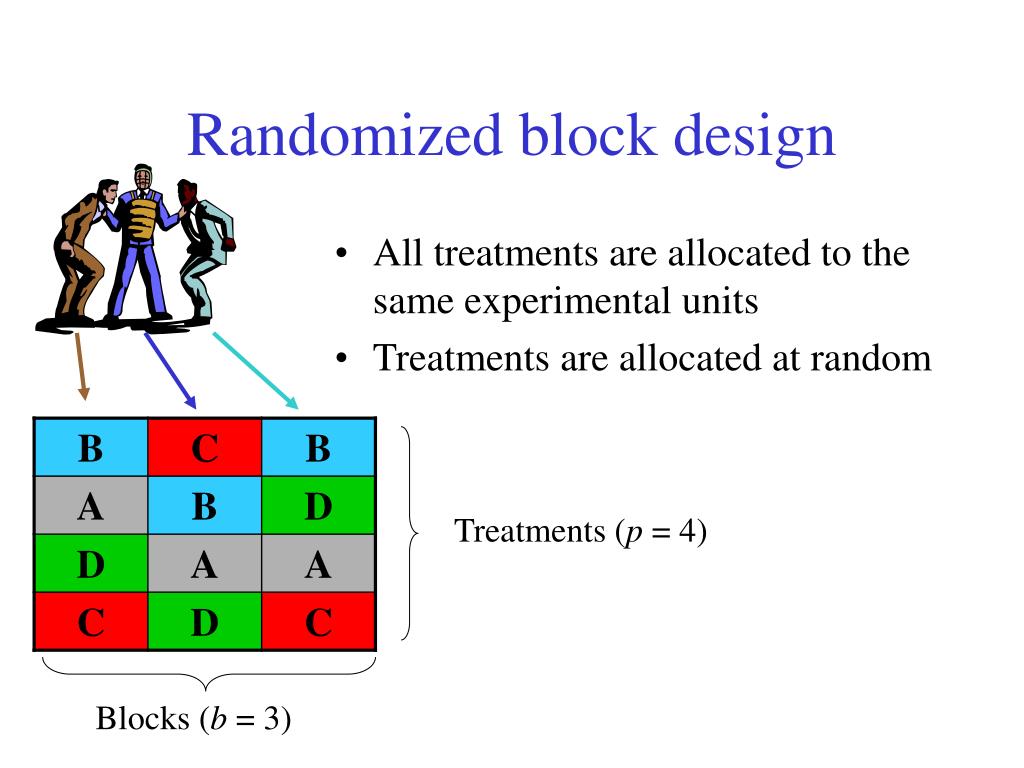
In a completely randomized design, treatments are assigned to experimental units at random. This is typically done by listing the treatments and assigning a random number to each. Combining the two species, 32 ± 4.7% of the papers were judged to have been designed and randomised to an acceptable standard, although none of them stated that they had used either the CR or RB design. Scientists wishing to build repeatability into their experiments could use the RB design, spreading the blocks over a period of time.
In doing so, the error variance will be reduced since part of the error variance is now explained by the blocking variable. When the numerator (i.e., error) decreases, the calculated F is going to be larger. We will achieve a smaller P obtained value, and are more likely to reject the null hypothesis. In other words, good blocking variables decreases error, which increases statistical power.
The spread of local anesthetic from the erector spinae plane to the epidural or paravertebral space depends above all on the volume of injected local anesthetic. Potential complications include circulatory changes (hypotension), unintended motor blockades and possible systemic toxicity at high LA doses. In adults, it is considered safe to use a local anesthetic volume of 20 to 30 ml [3, 23, 27, 28]. Two patients were excluded from the study—one patient did not complete the study and the surgery plan was changed for the other patient. The remaining 58 patients were randomly divided into two equal groups of 29 each (Fig. 3).


No comments:
Post a Comment